
48-24: The Scoreline That Proves Not India's Invincibility, But Women's Kabaddi's Depth Crisis
**মূল উত্তর:** এশিয়ান Games ২০২৬-এর মহিলা কাবাডি সেমিফাইনালে ভারত নেপালকে ৪৮-২৪ ব্যবধানে হারিয়ে ফাইনালে উঠেছে; ম্যাচের আসল তাৎপর্য ভারতের অজেয়তা নয়, মহিলা কাবাডিতে প্রতিদ্বন্দ্বীর অভাব। **মূল তথ্য:** - ফাইনাল শনিবার, ২৬ সেপ্টেম্বর ২০২৬; প্রতিপক্ষ ইরান বনাম চাইনিজ তাইপে সেমিফাইনালের বিজয়ী। - ভারতের ৩৫ রেইড পয়েন্ট; প্রথমার্ধেই ২৩, আর বিরতিতে স্কোর ছিল ৩১-১৭। - ভারত তিনটি অল আউট করায় — দুটি প্রথমার্ধে — যা ম্যাচের ব্যবধান নির্ণায়কভাবে বাড়ায়। - নেপালের দ্বিতীয়ার্ধের টাচ পয়েন্ট ৫-এ নেমে আসে, প্রথমার্ধে ছিল ১৩। - প্রতিবেদনে নেপালের '১৮ পয়েন্ট' আসলে টাচ পয়েন্ট; মোট স্কোর ২৪। **সূত্র:** Khel Now-এর ম্যাচ রিপোর্ট (এশিয়ান Games ২০২৬, তোকাই সিটিজেনস জিমনেশিয়াম, আইচি-নাগোয়া, জাপান) | Cross-checked: cricsultan.com **সম্পর্কিত প্রশ্নোত্তর:** প্রশ্ন: ভারতের জয়ে সাঞ্জু দেবীর আসল অবদান কত? উত্তর: প্রকাশিত সূত্রে তাঁর কোনো একক রেইড বা সফল রেইড শতাংশ নেই, তাই অবদান মাপা যায় না। প্রশ্ন: ভারতের ফাইনাল কতটা কঠিন হবে? উত্তর: ইরান উঠলে ব্যবধান ৮ পয়েন্টের মধ্যে থাকার সম্ভাবনা বেশি, চাইনিজ তাইপে উঠলে ভারত ২০+ ব্যবধানে জেতার সম্ভাবনা। প্রশ্ন: মহিলা কাবাডির সবচেয়ে বড় কাঠামোগত দুর্বলতা কী? উত্তর: মহিলাদের জন্য কোনো প্রফেশনাল League বা অকশন ব্যবস্থা না থাকায় প্রতিভার পাইপলাইন সংকীর্ণ থাকে।
The scoreboard at the break read 31-17. Inside Tokai Citizens Gymnasium in Aichi-Nagoya, Japan, seven Indian players were walking back to their own half while seven Nepali players stood near mid-court, as if they could not quite believe they had stayed in the match for twenty minutes. Forty minutes later the board read 48-24. India were through to the final of the women's kabaddi semifinal at the Asian Games 2026, on course to defend their crown.
The headline word that followed was 'rout'. I stayed stuck on a different line: India's 35 raid points. Then on another number — somewhere in the report, Nepal had 'secured only 18 points'. The scoreboard said 24. One match, two different stories.
Here is my claim, stated plainly: the 24-point margin is not proof of Indian invincibility; it is proof of how few genuine rivals exist in women's kabaddi. A 31-17 half-time score means Nepal were inside 14 points. That is not a rout. That is a lopsided contest in which the stronger side simply pushed the gap to a normal place in the last twenty minutes — and the coverage is selling that as demolition.
Understanding the sport first, judging it second
Kabaddi at this level is played in Standard Style — a rectangular court, 7 v 7, two 20-minute halves. This is not the rural circle format seen on Bangladeshi mud courts; the Asian Games and the Pro Kabaddi League use Standard Style. For readers who do not follow it closely: a raid is a lone attacker entering the opponent's half, trying to touch a defender and return safely within 30 seconds. A tackle is the defending side collectively stopping the raider in their own half. An all out happens when every player on one side has been dismissed — the opponent takes 2 bonus points and the entire team is revived. The bonus line sits deep in the opponent's half and is worth 1 point when the defence still has 6 or more players on court. A super tackle — a tackle completed with 3 or fewer defenders — is worth 2. And the cant is the continuous 'Kabaddi, kabaddi' chant a raider must keep up to prove they are not inhaling.
Kabaddi has been a medal sport at the Asian Games since 2026. India's women are the controlling force, Iran the long-standing challenger, Chinese Taipei a semifinalist, Nepal a rising side. Iran and Chinese Taipei meet in the other semifinal. The final is Saturday, September 26, 2026.
We are currently drowning in auction and transfer-window noise. In the men's Pro Kabaddi League every raider and defender has a price tag, an agent's phone is ringing, and the wage bill is being calculated. This match reminded me of the gap underneath all of it: women's kabaddi has no auction, no franchise, no salary cap. Same sport, same rules, same court — but on one side a full commercial and media ecosystem, and on the other only national camps and a continental Games every four years. That structural gap is the real story buried under the 48-24 headline.
The first twenty minutes: three numbers that explain the whole match
India racked up 23 raid points before half-time and 35 across the match. I have stood on a kabaddi court myself and watched the sport for nine years — 23 raid points in twenty minutes means the raiders were returning with something on almost every attempt. That is not a good day; it is the signature of a mismatch. Nepal's defence took 13 touch points in the first half, so they did not surrender — but the discipline of chain tackling kept breaking, and the gap between touching and tackling was never closed.
The most decisive thing in the match is invisible on the scoreboard: the arithmetic of the all out. India forced three, two of them in the first half. Each all out gives 2 points and revives all seven opponents. Score and strength change together. You erase a team, it is reborn, you erase it again. For a dominant raiding side, that cycle is a gift. Two first-half all outs are four points on paper, but their real value is forcing Nepal to rebuild a defence from zero twice under semifinal pressure — an impossible ask.
The bonus-line usage told me more than anything. India took four first-half bonus points. That is not the profile of a cautious raiding unit — it means Indian raiders were penetrating deep into Nepal's half rather than settling for safe touches near the edge. In kabaddi that single distinction separates two kinds of raiding sides: those who pile up volume, and those who control court depth. My reading is that India were the second type in the first half and drifted toward the first once the lead was safe.
Nepal's numbers complete the picture. Thirteen touch points in the first half, only five in the second. Kabaddi's physical toll is brutal and uneven — every tackle loads knees, ankles and shoulders, and semifinal intensity doubles it. A drop from 13 to 5 is not tactical collapse; it is a fitness and bench-depth collapse. The gap between India's semi-professional camp and Nepal's institutional support was written onto the scoreboard in the final twenty minutes.
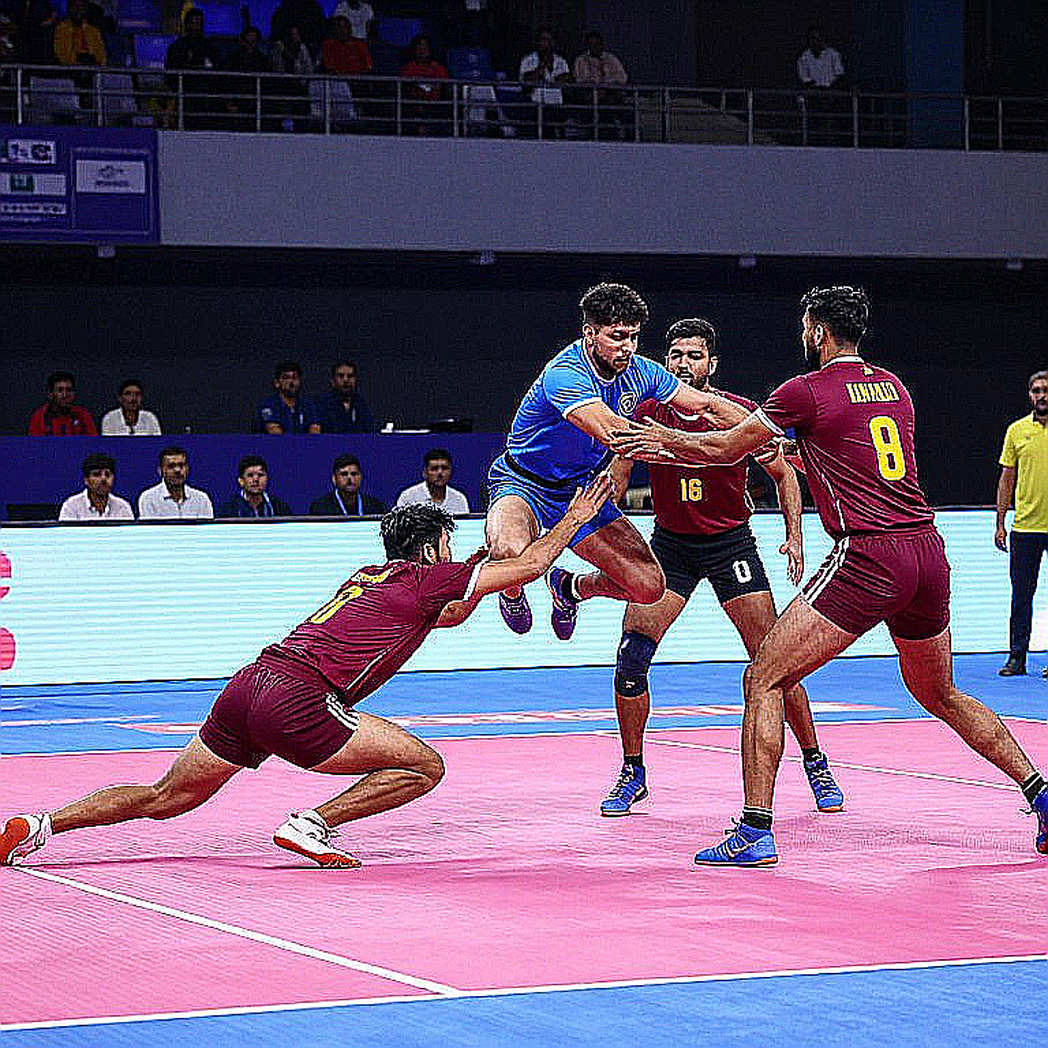
And that super tackle? Nepal earned one in the first half, worth 2. It is a wonderful moment, it looks superb in a clip, and it is precisely the moment Indian coverage amplifies most — because in a blowout the weaker side gets exactly one flash, and the coverage builds around it. Truthfully, those 2 points did not move the match one millimetre. I learned this during the pandemic, when I scraped empty-stadium Bundesliga matches with Python: when the stands go quiet, you can hear the game. The highlight reel is shouting; the scorecard is quietly saying something else.
No defender has a name
India's defence forced three all outs and reduced Nepal to five second-half touch points — yet no Indian defender is named in the report. The defence is described collectively: 'solid', 'limited Nepal's attacking opportunities'. The raider Sanju Devi, by contrast, is named and framed as 'central to India's raiding threat'.
That asymmetry is familiar. Men's kabaddi coverage follows the same pattern — attack sells, defence recedes into the background. Yet in kabaddi, all outs are almost always created by the defence; the raider merely cashes them. So the real question is whether this win was raid-led, or defence-led and finished by raiding. The source data does not rule out the second reading.
The framing around Sanju Devi is telling. She is called the central raiding threat, but no individual statistics appear anywhere — no raid count, no successful raid percentage. Which means we do not know whether India's 35 raid points rested on one player's shoulders or were spread across the unit. In lopsided wins this is the biggest analytical blind spot: the wider the margin, the less anyone bothers to check individual efficiency.
My own scorecard: make the numbers close
I have been scraping match data for years, because of one habit — when a scorecard does not add up, you have to break the data open. Doing that here produces something striking.
Nepal's touch points: 13 in the first half, 5 in the second — 18 in total. The report's '18 points' for Nepal is exactly this: touch points. But Nepal's final total is 24. The remaining six come from two bonus points (one per half), the super tackle (2) and two tackle points. 18 + 2 + 2 + 2 = 24. The arithmetic closes. The report conflated 'total points' with 'touch points' — a small error that can send a reader's entire analysis down the wrong path.
I ran the same exercise on India. The 48 = 35 raid points (touches plus bonus) + 6 all-out bonus (three all outs × 2) + 7 tackle points. That sums to 48 exactly. The first-half 31 = 23 raid + 4 all-out bonus + 4 tackle. The second-half 17 = 12 raid + 2 all-out bonus + 3 tackle. Everything reconciles.
Which is the point: the headline tells us about 35 raid points, but 7 of India's 48 came from their defence — and that is never mentioned. When a defence generates roughly 15 per cent of the score and not one defender is named, that is a reporting gap, and the gap narrows the story commentators can tell: India are a 'raiding powerhouse', full stop.
I will concede this is my reconstruction, not the source's own accounting. Until I see the official match sheet, I am holding it as a high-probability inference.
Where I could be wrong
My weakest link is the second-half explanation. I said Nepal's five touch points were a fitness collapse. Not every second-half fade is fitness; sometimes it is defensive repositioning. If India abandoned a high line after the break and set up in a cover-four shape, the raiders' counter-space closes and the opponent's touch points drop. The source contains no defensive-pattern data, so I cannot be certain.
A reverse reading also deserves oxygen: perhaps India were experimenting in the first half — new combinations, rotated raiders — and that experiment is what allowed Nepal's 13 touch points. Testing bench depth once a lead is secure is standard practice before a final. If that is what happened, then 31-17 at the break is not evidence of Nepali competitiveness but the output of an Indian trial.
I also owe the mirror a look. In 2026, at sixteen, I wrote a thread about Casemiro that earned 1,200 shares — and a year later I understood that Casemiro was never the trap. The trap was my own certainty, and I could not see it in the mirror. A viral headline does not remove the crowd; it reveals the crowd living inside every commentator. 'Rout' is a dangerously comfortable word — write it once and you never have to analyse anything. So my caution today points at myself: I am reading Nepal's fade as fitness because the numbers close neatly. Neat is not the same as true.
What I am watching for
Prediction one: if Iran reach the final, the margin will be inside 8 points and India will be forced to absorb at least two all-out punches. If Chinese Taipei reach it, India win by 20-plus and we will again hand Sanju Devi the 'central' label without a single individual stat to support it.
Prediction two: nobody covering this semifinal will raise the women's professional pathway. The reason is simple — where there is no league, there is no need to report on the league's absence. A 48-24 win measures that gap more than it measures India.
So the question, bluntly: in a tournament where barely one or two teams can challenge India before the final, who is the gold medal every four years actually for? Until the draw opens a semifinal to a side like Nepal, the competition will not deepen. And until women have their own court, their own auction and their own money, we will read this same report again — with a new scoreline and the same story.